
Abstract
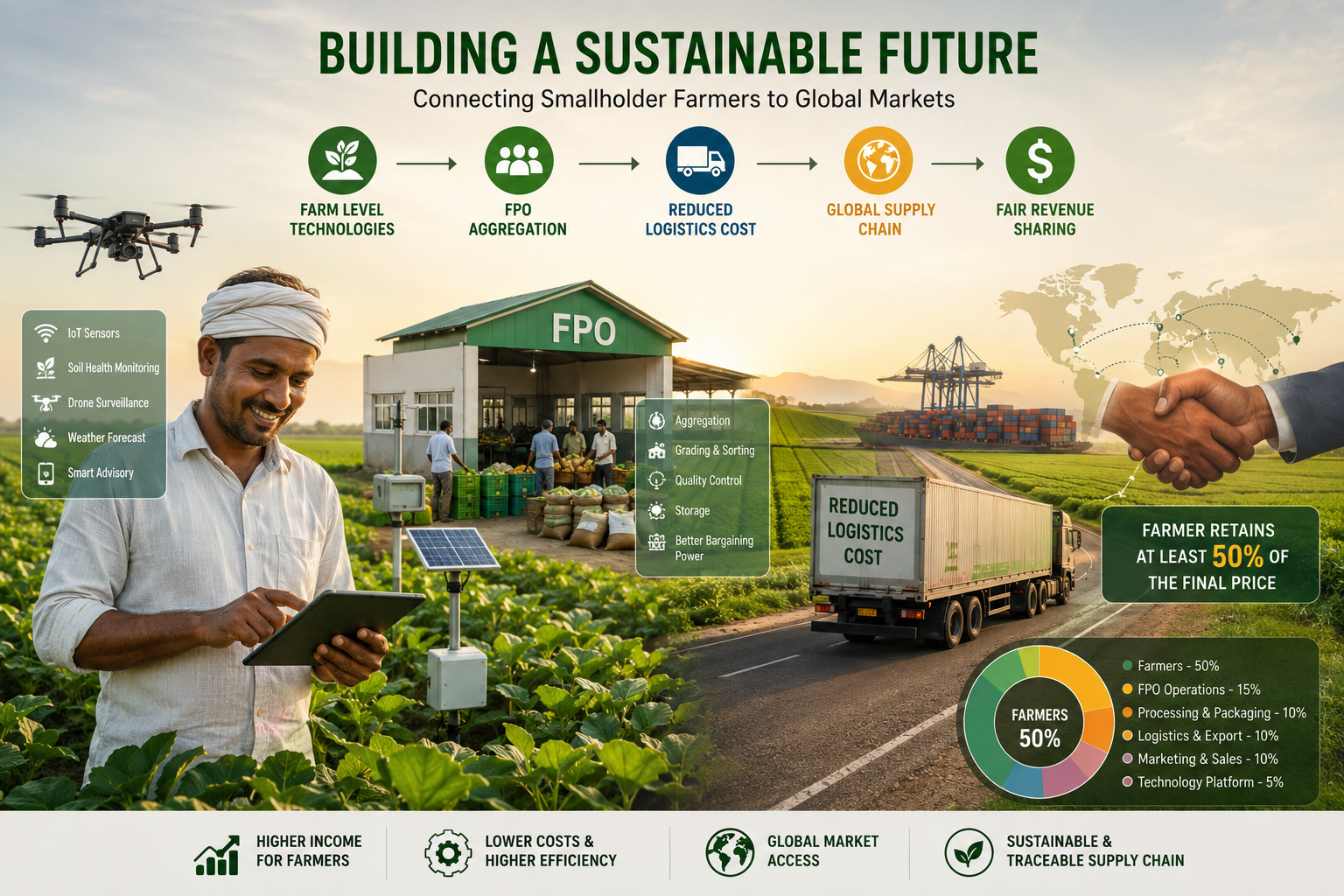
Smallholder farmers produce a significant share of the world's agricultural commodities, yet they often capture only a small portion of the final consumer price due to fragmented supply chains, inefficient logistics, limited market access, and information asymmetry. This paper proposes a five-year Agro-Business Partnership Model (ABPM) that integrates digital agriculture, Farmer Producer Organizations (FPOs), and international buyers into a transparent, technology-driven ecosystem. The model focuses on three critical objectives: (1) deploying modern farm-level technologies to improve productivity and traceability, (2) leveraging FPOs to reduce logistical and transaction costs, and (3) implementing a revenue-sharing mechanism that guarantees farmers retain at least 50% of the final market price. By combining precision agriculture, digital traceability, aggregated logistics, and equitable contracting, the model aims to create sustainable income growth while meeting international quality and compliance standards. Research indicates that digital integration, traceability systems, and FPO-led aggregation can significantly improve market efficiency and farmer income realization.
1. Introduction
Agricultural globalization has created unprecedented opportunities for smallholder farmers to access premium export markets. However, most farmers remain disconnected from international supply chains due to challenges including fragmented landholdings, inconsistent quality standards, weak logistics infrastructure, and limited bargaining power. Studies show that digital integration and farmer aggregation models can reduce inefficiencies and increase the share of value captured by producers.
The proposed Agro-Business Partnership Model seeks to transform smallholder farming from a production-focused activity into a market-oriented enterprise by building long-term partnerships among farmers, FPOs, agribusinesses, exporters, logistics providers, and international buyers.
2. Strategic Objectives
The roadmap is designed around four measurable goals:
Increase farmer income by at least 75% within five years.
Ensure farmers retain a minimum of 50% of the final export market value.
Reduce post-harvest losses by 30–40%.
Establish full traceability and compliance with international market requirements.
3. Technology Deployment at Farm Level
Year 1: Digital Foundation
Farmer Digital Identity
Each farmer receives:
Digital farm profile
Geo-tagged land records
Crop history database
Mobile application access
Mobile Advisory Platform
The platform provides:
Weather forecasts
Pest and disease alerts
Market price updates
Fertilizer recommendations
Digital advisory tools improve decision-making and connect farmers with market information and modern agronomic practices.
Soil Health Digitization
GPS-based soil testing
Nutrient mapping
Fertility recommendations
Year 2: Precision Agriculture
IoT Sensors
Deployment includes:
Soil moisture sensors
Temperature sensors
Irrigation monitoring systems
IoT-enabled agriculture improves resource efficiency and supports data-driven farm management.
Drone-Based Monitoring
Applications include:
Crop health assessment
Pest surveillance
Nutrient deficiency detection
Yield forecasting
Year 3: Traceability and Compliance
QR-Based Farm Traceability
Each harvest batch receives:
Farmer identification
Production records
Input usage history
Harvest details
Traceability systems improve transparency and help producers meet international sourcing requirements.
Blockchain-Enabled Supply Chain Records
Benefits include:
Tamper-resistant documentation
Export compliance verification
Buyer confidence enhancement
Blockchain technology has shown strong potential for agricultural supply-chain transparency and trust building.
Year 4: AI-Powered Decision Support
Predictive Analytics
Artificial intelligence will be used for:
Yield prediction
Pest outbreak forecasting
Market demand forecasting
Export planning
Smart Input Recommendations
Customized recommendations for:
Seeds
Crop protection products
Fertilizers
Irrigation scheduling
Year 5: Fully Integrated Smart Farming Ecosystem
Digital Twin Farms
Each participating farm operates with:
Real-time monitoring
Automated advisory services
Sustainability scoring
Carbon footprint tracking
This stage enables direct integration with international procurement systems.
4. Role of FPOs in Reducing Logistical Costs
Farmer Producer Organizations serve as the operational backbone of the model.
Aggregation Function
Instead of exporting produce from individual farms, FPOs aggregate output from hundreds of farmers.
Benefits:
Larger shipment volumes
Reduced transportation costs
Better bargaining power
Lower transaction expenses
Successful FPO-centered digital logistics models have demonstrated substantial reductions in operational costs while improving market access.
Collection and Processing Centers
Village Collection Hubs
Functions include:
Primary grading
Quality testing
Digital inventory recording
Regional Processing Centers
Functions include:
Cleaning
Sorting
Packaging
Cold storage
Research suggests that primary processing centers integrated with digital platforms can significantly improve supply-chain efficiency and reduce post-harvest losses.
Shared Logistics Infrastructure
FPOs coordinate:
Truck pooling
Cold chain facilities
Warehouse utilization
Export consolidation
This reduces logistics costs by spreading fixed costs across larger volumes.
Export Facilitation
FPO responsibilities include:
Export documentation
Compliance certification
Quality assurance
International buyer coordination
Large-scale FPO-led models demonstrate that collective ownership and integrated export logistics can successfully connect thousands of farmers to international markets.
5. Revenue-Sharing Mechanism
Principle
The model guarantees that farmers retain at least 50% of the final market price.
Example
Final export sale price:
₹100 per kg
Revenue Distribution
StakeholderShare (%)Amount (₹)Farmers50%50FPO Operations15%15Processing & Packaging10%10Logistics & Export10%10Marketing & Sales10%10Technology Platform5%5
Incentive Bonus Structure
When export prices exceed predetermined thresholds:
Premium Distribution
Additional profits distributed as:
70% to farmers
20% to FPO
10% to platform operators
This aligns incentives across the value chain.
Quality Incentives
Farmers receive bonuses for:
Residue-free produce
Organic certification
Export-grade quality
Sustainability compliance
6. Five-Year Implementation Timeline
YearFocus AreaKey DeliverablesYear 1Digital OnboardingFarmer registration, soil mapping, mobile platformYear 2Precision AgricultureIoT deployment, drones, irrigation optimizationYear 3TraceabilityQR tracking, blockchain records, export complianceYear 4AI OptimizationPredictive analytics, market forecastingYear 5Global IntegrationDirect international contracts, smart farming ecosystem
7. Expected Outcomes by Year Five
Economic Impact
75–100% increase in farmer income
50% minimum share of final market value retained by farmers
20–30% reduction in input costs
Operational Impact
30–40% reduction in post-harvest losses
25–35% reduction in logistics costs
Full digital traceability
Market Impact
Direct access to international buyers
Premium export market participation
Enhanced brand reputation for farmer-grown products
Conclusion
The Agro-Business Partnership Model presents a scalable framework for integrating smallholder farmers into international supply chains while ensuring equitable value distribution. By combining precision agriculture technologies, FPO-led aggregation, digital traceability, and transparent revenue-sharing, the model addresses the structural barriers that have historically limited farmer profitability. The proposed five-year roadmap creates a pathway toward a more efficient, transparent, and inclusive agricultural ecosystem where farmers are not merely suppliers but strategic partners in global agribusiness. Supported by modern digital tools and strong producer organizations, the model can significantly enhance rural livelihoods while meeting the quality, sustainability, and traceability requirements of international markets.